Understanding the behaviour of connections is of major importance.
As a young engineer 52 years ago, I worked for nearly a year in London in a consulting engineers office analysing the friction grip bolted connections of the REDESIGNED Westgate Bridge in Melbourne, which had previously collapsed during construction, resulting in 35 fatalities.
As the calculations progressed, I became acutely aware of the inconsistencies in assumptions of behaviour of bolted connections, particularly the vague assumptions concerning the redistribution of forces during slip.
Equally important was the mis-match of the calculated force distributions in steel box girder members with the capacity of the adjacent bolted connections to transmit forces to the neighbouring boxes.
While there were no resulting failures reported, the lesson (for me) was that engineers need to consider in detail the behaviour of any structure as a whole, the behaviour of its component parts, AND the means of ensuring consistency in such calculated behaviour.
Structural engineering analysis has benefited greatly during the last 52 years from the use of computers. No longer do we depend on the slide rule. and AI will take us to the next level of sophisticated analysis.
But the lessons are still valid.
Engineers (the humans who must accept responsibility for analysis and design) must first understand the behaviour of our structures, the components and the connections.
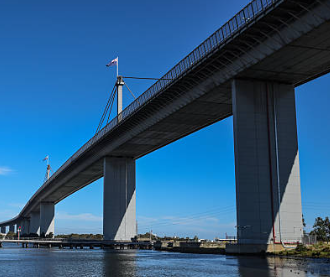
Source: westgate bridge – Search Images